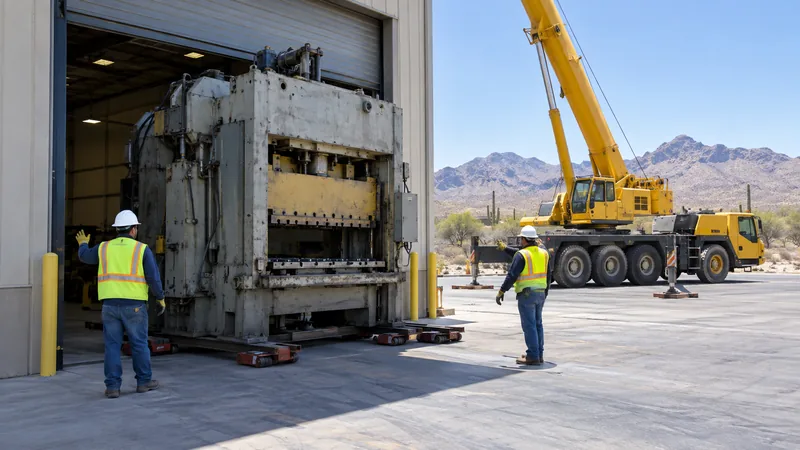
How Do You Prepare for a Machinery Move? A Planning Checklist for Facility Managers
The short answer: Get the machine’s real weight, dimensions and center of gravity, measure every door, floor and turn between the old spot and the new one, and decide in writing who disconnects, moves, sets and reconnects the machine. Have the machine shut down, isolated, drained and labeled before the riggers arrive. If the machine has to go outside, onto a truck, onto a roof or through a roof opening, treat the crane lift as its own plan with its own site preparation.
A machinery move rarely goes wrong on move day. It goes wrong in the planning, when a weight is guessed, a doorway is measured by eye, or nobody owns the job of draining the coolant. This checklist covers the owner’s side of the job. If you want the basics first, start with our guide to machine moving and rigging.
Start with the information your rigger needs to quote
A rigger can’t give you an accurate price or plan from “a big press in the back of the shop.” The more of this you can provide up front, the fewer surprises there are on the day.
| What to gather | Why it matters | Where to find it |
|---|---|---|
| Make, model and serial number | Lets the crew look up the manufacturer’s rigging and lifting instructions | Nameplate on the machine |
| Weight, including attached tooling and fluids | Sets the size of the skates, jacks, rigging and crane | Manual, nameplate, spec sheet, or the manufacturer |
| Length, width and height | Checked against every door, aisle and truck deck | Tape measure; don’t rely on catalog numbers after modifications |
| Center of gravity and lift points | A top-heavy or off-center machine can tip or swing if it’s picked wrong | Manual or manufacturer; mark lifting eyes and forklift pockets |
| Photos from all sides | Shows anchors, attached conduit, piping and obstacles | Your phone |
| Start and end locations | Distance, floor type, ramps, elevators, docks, rooftops | Floor plan or site plan |
| Your deadline and downtime window | Decides crew size and whether nights or weekends are needed | Production schedule |
If a crane is part of the move, the weight and the distance from the crane to where the load is picked or set both matter. Crane capacity drops as that distance grows, which is why a light machine far from the truck can need a bigger crane than a heavy one close by. Here is more on how crane lifting capacity changes with radius.
Decide who handles what
Most delays come from gaps between trades. Put the split in writing before the quote is final.
| Task | Usually the owner or the owner’s trades | Usually the rigging and crane contractor |
|---|---|---|
| Shutting down and isolating power, air, gas and water | ✓ | |
| Draining oils, coolant and hydraulic fluid | ✓ (or a contractor the owner hires) | |
| Disconnecting and reconnecting utilities | ✓ (licensed electrician, plumber) | |
| Removing guards, loose tooling and parts that could shift | ✓ or shared | |
| Rigging, skating, jacking and lifting the machine | ✓ | |
| Crane selection, setup and the lift itself | ✓ | |
| Trucking and securing the load | ✓ or a heavy haul carrier they coordinate | |
| Setting, leveling and anchoring at the new spot | Shared; confirm with your quote | ✓ |
| Final alignment, calibration and start-up | ✓ (maintenance team or manufacturer’s technician) |
This is a common split, not a rule. Some rigging contractors take on more of it. What matters is that every line has a name next to it.
Decommission the machine before move day
Riggers should arrive to a machine that is ready to move, not one that is still running.
- Isolate every energy source. That includes electrical power, compressed air, hydraulics, gas, springs and anything that stores pressure. OSHA’s rule on the control of hazardous energy (29 CFR 1910.147) covers lockout and tagout for servicing machines. Follow your own lockout program here.
- Drain fluids. Oil, coolant and hydraulic fluid add weight, shift during a move and can spill. Plan how the fluids will be captured and disposed of.
- Label and photograph connections. Tag every wire, hose and fitting before it’s disconnected. Photos make reconnecting much faster.
- Secure moving parts. Lock slides, tables, heads and doors so nothing travels during the move. Use the manufacturer’s shipping brackets if the machine came with them.
- Remove loose items. Tooling, parts bins, stored material and anything sitting on or inside the machine should come off.
- Unbolt the anchors. Know how the machine is fastened to the floor and whether the anchors will be cut, pulled or left in place.
Walk the path: doors, floors and turns
Walk the whole route from the machine’s current spot to its new one, with a tape measure.
- Openings. Measure the width and height of every door, overhead door, hallway and aisle. Check low beams, pipes, lights, sprinkler heads and ductwork along the way.
- Turns. A long machine needs room to swing through a corner, not just to fit through a straight doorway.
- Floors. Concentrated loads under skates or jacks can crack slabs, break trench drain covers and damage floor finishes. If you’re not sure the floor can carry the load, ask your facility engineer. Ask whether steel plates or cribbing are needed.
- Ramps, docks and elevators. Note slopes, dock heights and the rated capacity of any freight elevator on the route.
- Clear the route. Move racks, pallets and parked equipment before the crew arrives, and plan how you’ll keep people out of the path during the move.
When a crane becomes part of the move
Many machinery moves need a crane for at least one step: loading or offloading a truck, setting equipment on an outdoor pad, placing a unit on a roof, or lifting a machine through a roof opening or over a building. Once a crane is involved, the ground and overhead space outside matter as much as the floor inside.
- Crane setup area. The crane needs a firm, level, drained place to set up and space for its outriggers. OSHA’s crane rule on ground conditions (29 CFR 1926.1402) makes the controlling entity on the job site responsible for that ground and for telling the crane operator about known hazards under the setup area, such as voids, tanks and utilities.
- Power lines. Check for overhead lines near the setup area and the swing path. OSHA’s power line safety rule (29 CFR 1926.1408) sets minimum clearances by voltage, and larger lines need more room.
- Access and traffic. Plan truck access, street or parking lot closures and where people will be kept clear while the load is in the air.
For the full outdoor setup, including ground checks, outrigger space and utility marking, see our checklist for preparing your site before the crane arrives.
When the lift and the move are handled by separate companies, somebody has to coordinate the handoff between the crane and the rigging crew. Hook Crane Services employs operators, riggers, drivers and job coordinators, and its NCCCO- and MSHA-certified operators run a fleet of 11 cranes from a 17-ton boom truck to a 165-ton crane. Learn more about our rigging and crane contracting in Tucson.
Prepare the new location and plan the reinstall
The move isn’t finished until the machine is running in its new spot.
- Mark the final position on the floor, including orientation and the clearances the machine needs for maintenance access.
- Confirm the foundation. Some machines need a specific slab, pad or anchor pattern. Have it cured and ready before move day.
- Have utilities waiting. Power, air, water and drains should be run to the new location so reconnection can start as soon as the machine is set.
- Plan leveling and anchoring. Decide who levels and anchors the machine and to what tolerance.
- Schedule start-up. Line up your maintenance team or the manufacturer’s technician for alignment, calibration and test runs.
Scheduling a machinery move in Southern Arizona
Weather affects crane work more than work inside a building. Summer heat affects crews and equipment, and monsoon storms bring sudden wind, lightning and rain. Both can pause a lift. Build in some flexibility if part of the move happens outdoors between June and September. Our posts on crane work during monsoon season and crane operations in desert heat explain what crews watch for.
Also plan around your own production. Moves are often scheduled for nights, weekends or planned shutdowns so the machine is down for as short a time as possible.
Machinery move checklist
Two to four weeks before – Machine weight, dimensions, center of gravity and lift points confirmed – Photos and floor plan sent to the rigging contractor – Responsibilities agreed in writing (disconnect, move, set, reconnect) – Route measured: doors, aisles, turns, overhead obstacles, floors – Crane setup area, power lines and access checked (if a crane is needed) – New location, foundation and utilities ready or scheduled
The week before – Route cleared of racks, pallets and stored material – Downtime window confirmed with production – Start-up technician booked
Move day – Machine shut down, locked out, drained, labeled and secured – Anchors removed and loose items cleared – Work area and lift zone closed to other staff – Contact person on site for the crew
Frequently asked questions
What do I need to tell a rigging company to get a quote?
Give them the machine’s make and model, its weight, its dimensions, photos from all sides, where it’s going, and your deadline. Mention anything along the route that could be a problem, such as narrow doors, a weak floor, stairs, a ramp or a rooftop destination.
Who disconnects the machine before it’s moved?
Usually the owner’s electrician, plumber or maintenance team handles utilities and draining. The rigging crew moves the machine. Agree on this in writing, because it changes both the quote and the schedule.
Do I need a crane to move heavy machinery?
Not always. Inside a building, machines are often moved on skates and jacks. You usually need a crane when the machine is loaded onto or off a truck, set on an outdoor pad, lifted onto a roof, or lifted over a building or through a roof opening.
How do I find the weight of my machine?
Check the nameplate, the operator’s manual or the manufacturer’s spec sheet. If the machine has been modified, has heavy tooling, or still holds fluids, ask the manufacturer or your rigger for help confirming the real weight. Don’t guess.
Can a crane lift my machine if I only know the weight?
The weight is only part of it. The crane also needs to know how far the load will be from the crane when it’s picked up and set down, how high it has to go, and where the crane can set up. That’s why a site visit or good photos help.
Planning a machinery move or equipment set in Southern Arizona? Call Hook Crane Services at (520) 323-0963 or request a free quote and tell us about the machine, the route and the deadline.