Boom Truck vs. Crane: Which Do You Need for Your Lift?
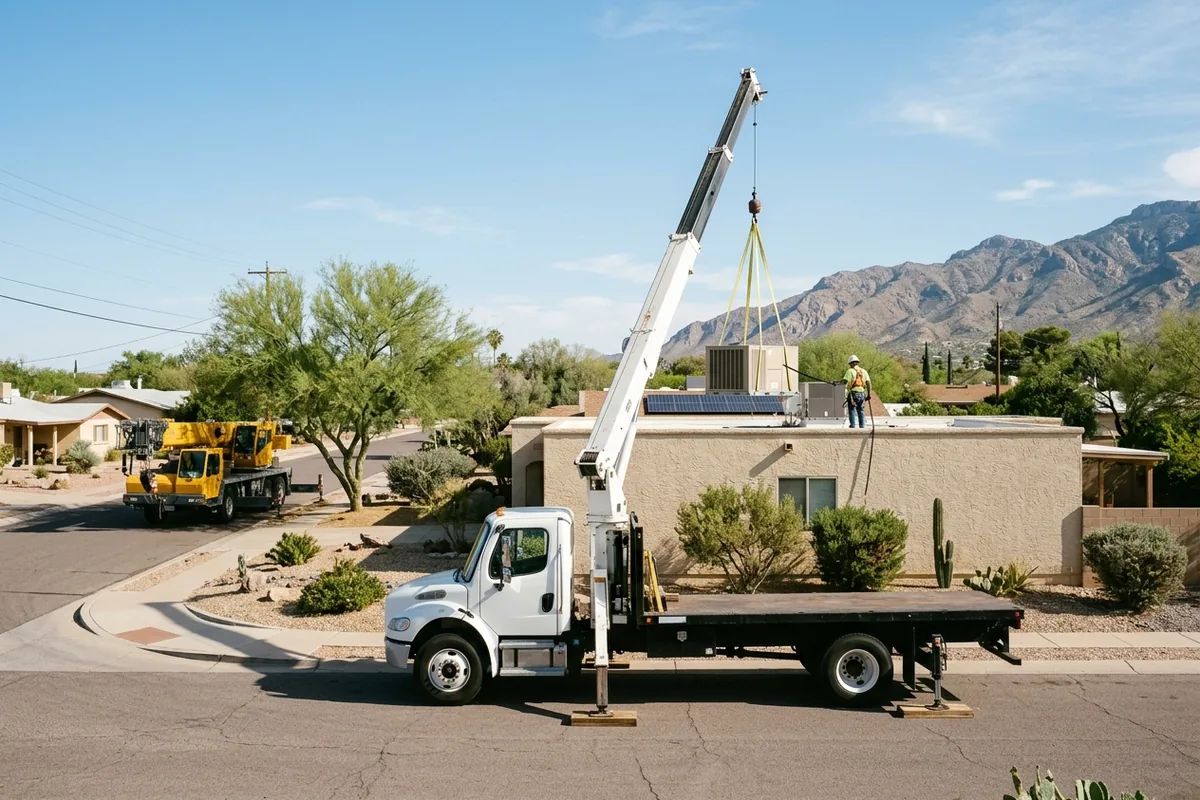
The short answer: A boom truck is a crane mounted on a commercial truck chassis. It drives to the job like a truck, sets up fast in a small footprint and is usually the most economical choice for lighter loads at modest reach, such as a residential AC unit, a monument sign or a bundle of trusses next to the street. A larger mobile hydraulic crane is the right call when the load is heavy, has to travel far from where the crane can park, or has to go high, such as a rooftop unit in the middle of a big commercial roof, a transformer or a cooling tower. The deciding number is not the machine’s tonnage. It’s what the machine can lift at the distance your load has to travel.
Picking the wrong machine costs you either way. Too small and the lift gets rescheduled on the day. Too big and you pay for setup time, travel and capacity you never use. This guide explains how the two machines differ and how crane contractors decide between them.
What is a boom truck?
A boom truck is a crane built onto a commercial truck chassis, usually with a flatbed behind the cab. The operator drives it on public roads like any heavy truck, extends the outriggers at the job and lifts with a hydraulic boom.
Boom trucks come with two main boom styles:
- Telescopic boom: a straight boom that extends in sections. It is good for reaching up and out in a straight line, for example from the street to a roof.
- Knuckle (articulating) boom: a boom that folds at hinged joints. It can reach over and around obstacles and folds up compactly for travel.
Many boom trucks can also carry material on their own deck, so one truck can deliver and set the load. That “haul and hoist” ability is a big part of why they are popular for signs, building materials and small equipment.
How is a mobile crane different?
A mobile hydraulic crane sits on a carrier designed around the crane rather than on a standard truck chassis. It has a longer, heavier telescopic boom, larger outriggers and counterweight, and much more capacity. The tradeoff is size: it needs more room to set up, more time to rig, and for the largest machines, support trucks to bring counterweight or rigging gear.
Hook Crane Services runs both. Its fleet of 11 cranes starts with a 17-ton boom truck with a 90-foot boom and jib and goes up through 40-, 50-, 70-, 90- and 130-ton cranes to a 165-ton crane with a 260-foot boom and jib.
Boom truck vs. crane at a glance
| Factor | Boom truck | Larger mobile hydraulic crane |
|---|---|---|
| Typical loads | Lighter loads: residential AC units, signs, trusses, small equipment | Heavier loads: large rooftop units, chillers, transformers, generators, steel |
| Reach | Modest reach; capacity drops quickly as the boom extends | Longer booms keep useful capacity farther from the crane |
| Setup footprint | Small; often fits in a driveway, alley or single lane | Larger outrigger spread; may need a lane closure or a cleared lot |
| Setup time | Usually fast | Longer, especially when counterweight is added |
| Haul the load | Often can carry the load on its own deck | Load usually arrives on a separate truck |
| Ground pressure | Lower outrigger loads, but still needs firm, level ground | Higher outrigger loads; mats or cribbing are common |
| Relative cost | Generally lower per hour | Generally higher per hour and for travel and setup |
When a boom truck is usually the right call
A boom truck tends to be the better fit when most of these are true:
- The load is relatively light and comes in one or a few picks.
- The truck can park close to the spot where the load is picked or set.
- The building is one story or the set height is modest.
- The site is tight: a residential street, a driveway, a parking lot between buildings.
- Moving between several stops in one day matters, for example setting signs or AC units at more than one address.
- The same truck can bring the material and set it.
Typical examples are a residential AC condenser or package unit lifted onto a single-story roof, a monument or small pylon sign, roof trusses on a house, a well-site pump change with a light assembly, or setting a piece of shop equipment off a trailer.
When you need a larger mobile crane
Move up to a bigger crane when any of these apply:
- The load is heavy. Transformers, generators, chillers, cooling tower sections and structural steel often exceed what a boom truck can handle at any useful reach.
- The load has to travel far. A rooftop unit in the center of a large commercial roof may be 60 or 80 feet from the nearest place a crane can set up. That distance, not the unit’s weight alone, is what sizes the crane.
- The lift is high. Multi-story buildings, tall signs and cell tower work need boom length and capacity at height.
- Obstacles force a long reach. Power lines, trees, canopies or other buildings can push the crane farther from the load.
- The ground or access is poor. Sometimes a bigger crane set up on a solid area far away is safer than a small machine parked close on weak ground.
Why the tonnage number alone can mislead you
A crane’s tonnage rating describes its maximum capacity in its strongest configuration: outriggers fully extended, boom short, load very close to the machine. Real lifts almost never happen there. As the boom extends and the load moves away from the crane, capacity drops, and it drops fast.
That is why a 17-ton boom truck cannot lift a 17-ton load across a yard, and why a light load far away can need a bigger crane than a heavy load close by. Operators and lift planners size the machine with the manufacturer’s load chart, using three numbers:
- The load weight, including rigging such as slings, spreader bars and hooks.
- The radius, the horizontal distance from the crane’s center of rotation to the load at pick and at set.
- The height the load has to clear and be set at.
If you want to understand the chart itself, here is how load charts and lifting capacity work.
Site questions that change the answer
Even with the right weight and distance, the site can change which machine works.
- Setup space. Outriggers need room to extend fully. A boom truck’s smaller spread is often what makes it possible on a residential street or in a narrow lot.
- Ground conditions. OSHA’s crane ground conditions rule (29 CFR 1926.1402) requires ground that is firm, drained and graded enough to support the crane, and requires the party in control of the site to tell the crane user about known hazards under the setup area, such as voids, septic tanks or buried utilities. Fresh fill, soft or irrigated soil and recently trenched areas all deserve a second look.
- Power lines. Under OSHA’s power line safety rule for cranes (29 CFR 1926.1408), equipment generally has to stay at least 10 feet from lines up to 50 kV, with larger distances for higher voltages, unless other procedures in the rule are followed. Overhead lines along a street can push the crane to a different spot and change the radius.
- Access and traffic. Gate widths, overhead canopies, sharp turns and whether a lane can be closed all affect what can get in and where it can set up.
Before lift day, it helps to know how to prepare your site before the crane arrives.
Common lifts and where they usually start
These are starting points, not guarantees. The final choice always comes from the load chart and a look at the site.
| Job | Usual starting point | What can push it to a larger crane |
|---|---|---|
| Residential AC unit on a one-story house | Boom truck | Roof far from the street, two-story house, power lines over the driveway |
| Rooftop unit on a small commercial building | Boom truck or 40-ton crane | Larger unit, set point deep in the roof, taller building |
| Chillers and cooling towers | Larger mobile crane | Weight and the distance to the set point |
| Monument or small pylon sign | Boom truck | Tall pylon, heavy cabinet, long reach over landscaping |
| Residential roof trusses | Boom truck | Long reach to the back of the house, large bundles |
| Transformers and generators | Larger mobile crane | Weight; distance from the pad to where the crane can set up |
| Well-site pump changes | Depends on depth and assembly weight | Long column pipe, heavy pump assemblies, poor ground |
For rooftop mechanical work, see our guide to HVAC crane lifts, which matches common HVAC jobs to crane sizes. Hook Crane Services has provided operated crane services in Tucson since 1978, starting with two employees and one 10-ton boom truck, and today serves residential and commercial customers across Southern Arizona with NCCCO- and MSHA-certified operators.
What to send for a fast equipment recommendation
You don’t have to choose the machine yourself. Send these details and the crane contractor can match the equipment to the lift:
- What you are lifting and its weight, from the spec sheet or nameplate if possible.
- The size of the load (length, width, height) and any lifting points.
- Where the load starts (truck, ground, trailer) and where it has to go.
- The closest place a truck or crane can park, and roughly how far that is from the set point.
- Photos of the setup area, overhead lines and the set location.
- Building height, or the height the load has to clear.
- Your preferred date and any time window, such as early morning before the heat.
Frequently asked questions
Is a boom truck a crane?
Yes. A boom truck is a type of mobile crane. OSHA’s crane standard for construction (29 CFR 1926.1400) lists articulating (knuckle-boom) cranes and service trucks with hoisting devices among the equipment it covers, with a narrow exclusion for some material deliveries.
Does a boom truck operator need to be certified?
In construction work, crane operators generally must be certified or qualified under OSHA’s crane rules, and that includes many boom trucks. Hook Crane Services’ operators hold NCCCO and MSHA operator certifications.
Is a boom truck cheaper than a crane?
Usually, per hour, because it is a smaller machine that travels and sets up faster. But the cheapest machine is the one that can do the lift safely in one trip. A boom truck that can’t reach the set point costs more once you count the rescheduled day.
Can a boom truck lift an AC unit onto a roof?
Often, for residential and smaller commercial units when the truck can park close to the building. Larger units, taller buildings or a set point far from the street may call for a bigger crane.
How do I know which one I need?
Give the contractor the load weight, the distance from where the crane can park to the set point, the height, and photos of the site. They will check the load chart and tell you which machine fits.
Get the right machine for your lift
Not sure whether your job needs the boom truck or a bigger crane? Call Hook Crane Services at (520) 323-0963 or request a free quote with your load details and photos, and the team will recommend the equipment that fits your lift.